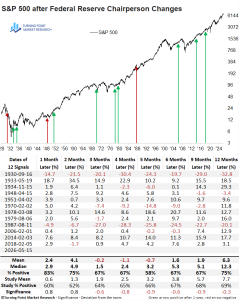


It’s been another impressive year for the S&P 500, with the world’s most benchmarked index recording 36 all-time highs year to date. Even more notable is that 31 of those record highs occurred within a rolling four-month window —a feat that has happened only eight other times since 1928.
Given the persistence of record highs, it must imply broad participation in the S&P 500. As the renowned market strategist, Bob Farrell, once said, “markets are strongest when they are broad and weakest when they narrow to a handful of blue-chip names.”
As we’ve pointed out on several occasions recently, the rally has been far narrower than it appears on the surface. In light of the weak market breadth, I wanted to examine how the current environment compares with other historical periods in which the S&P 500 achieved 31 record highs in 4 months.

Despite registering 31 record highs in just four months, market breadth looks terrible when compared to the other periods across five indicators. In fact, the percentage of S&P 500 stocks above their 50-day average ranks as the worst by a wide margin, and the other measures rank as the second weakest, trailing only 1929. Compared to prior advances, this record-setting phase shows unusually weak participation.
In case you were wondering, the 31st record high in 1929 occurred one day before the peak.

A persistent number of S&P 500 record highs over four months has typically been a sign of exhaustion, with the world’s most benchmarked index displaying unfavorable returns and consistency over the next eight weeks.

Each Chart of the Week highlights a theme, idea, or historic event that stood out to us. If you find it interesting, feel free to share it with friends or colleagues.
Visit www.tpmarketresearch.com to learn more about our research offering.